
Everybody Loves a Good Flood

In the summer of 2006, I remember having visited the district of Malda situated in northern West Bengal in connection with our research work on riverbank erosion. We were interested in finding out how the prolonged process of erosion causes slow, almost invisible displacement of population over decades. While many rivers of the region are historically known to have been eroding their banks, erosion of the Ganga deserves special mention. Erosion in the Ganga has been taking place over a 170-km stretch where the river flowing from the far-off Himalayas leaps into the floodplains of West Bengal from the Rajmahal Hills in the present state of Jharkhand. Part of this erosion is believed to be natural as the huge flow of the river aggravated by the gradient hits the soft earth of the floodplains. But, the problem, according to the experts, has been compounded by the commissioning of the Farakka Barrage back in 1975. The original purpose of the barrage was to flush about 40000 cusecs of water through a feeder canal connecting a 38-km stretch of the river in Farakka with the Bhagirathi (the main channel of the river) in Jangipur in the lower riparian district of Murshidabad. With the thinning flow of the Bhagirathi, the Kolkata Port was gradually losing its navigability. The purpose was to flush water through the river so that the Port could be resurrected. Contrary to the announced purpose, construction of the barrage further choked the waterflow into the bridging canal as the silt that the river carried particularly from the upstream started settling in the riverbed – thereby substantially reducing its depth and water-carrying capacity.

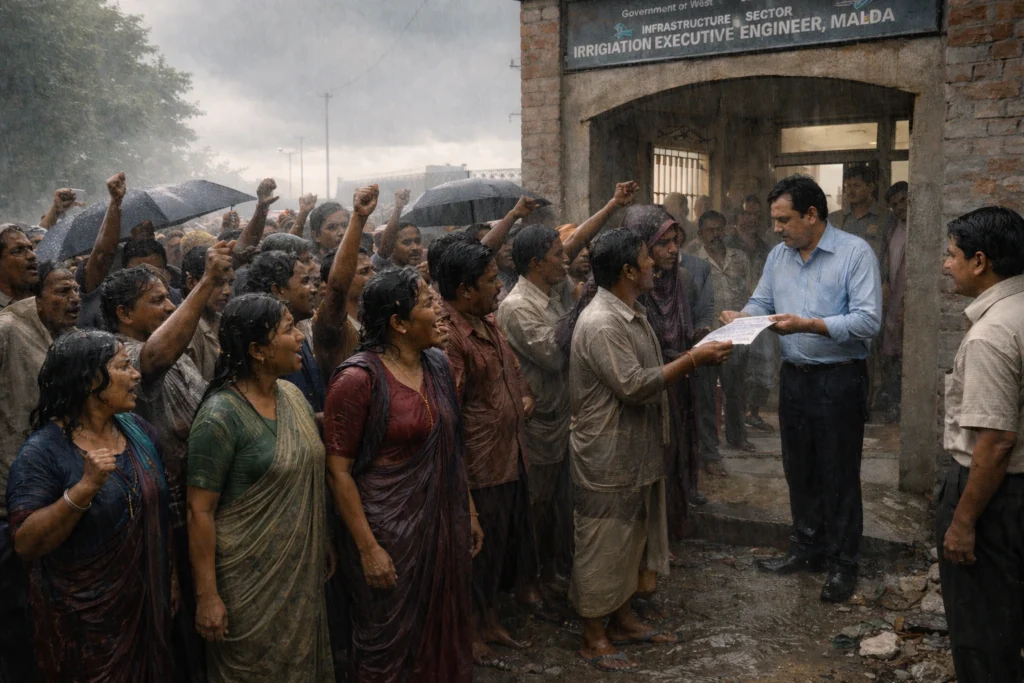
In 2006, when I was waiting in the office of the district executive engineer of irrigation, Government of West Bengal, for an interview, I found a batch of about 40-50 persons approaching the office briskly walking in a procession and shouting slogans. It was raining intensely outside and reports of havoc created by flood were reaching the district headquarters in Malda from different corners. After a while it became clear that the procession was organized by the Ganga-Bhangon Pratirodh Nagarik Action Committee (Citizens’ Action Committee for Resisting Erosion of the Ganges) on the occasion of the submission of a memorandum to the then executive engineer. I became inquisitive and on inquiry found out that the memorandum they wanted to submit highlighted the ‘futility’ of engineering measures (like construction of spurs and laying of boulders etc) hitherto undertaken by the department and urged it to immediately stop all such work. While describing flood as a ‘natural phenomenon’, the memorandum attributed riverbank erosion to the department’s exercise in controlling it by trying to keep the river within its existing narrow bed and tame in this manner its vengeful fury expressed through the torrential rain (too much of rain in too short a time) during monsoons by eroding the banks. Since the silt carried from the upstream is already settled in the riverbed and finds it difficult to be flushed through the barrier of Farakka Barrage, the riverbed remains heavily choked. The silt is not allowed to be carried to the sea thanks to the barrage. Sudden surge of water during monsoons only washes away the spurs and boulders which eventually settle in the already choked riverbed and further reduce its depth. This is the reason why the river refuses to remain confined to the riverbed and erodes the banks. 

I did not take much time to realize that the members of the aforementioned organization were protesting against the government’s policy of keeping the river restricted to the riverbed. They want the excess monsoon water carried by the river to flood the nearby plains adding to their fertility. Their larger demand was to eventually get the Farakka barrage decommissioned so that the silt gets washed away with the natural flow of the river. They would have loved floods, for, floods, agriculture and the floodplains are integrally connected in their life and livelihood. Floods turn into disasters insofar as the engineering solutions in such forms as spurs, boulders and embankments continue to choke the riverbed eventually forcing the river to erode the banks and bypass its bed.            


Post Tags:

Share: