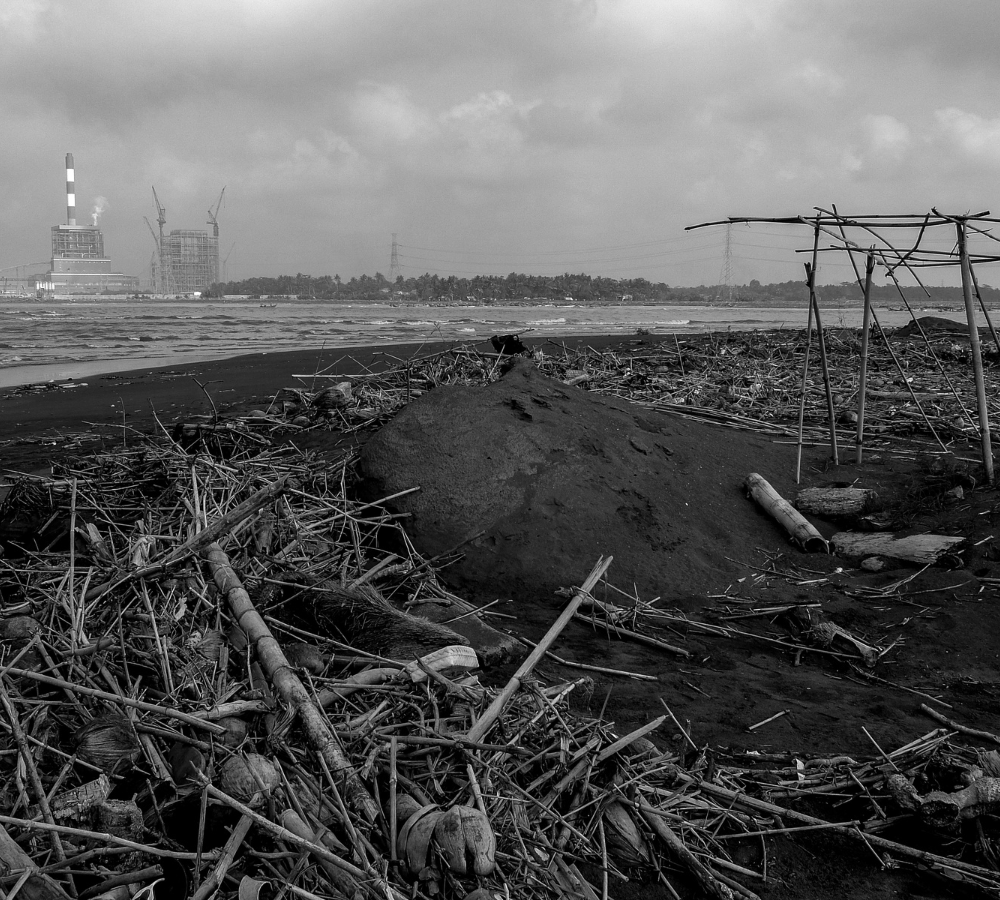
Repeated natural disasters striking the sub-Himalayan states almost at regular intervals have of late become an object of intense public debate in contemporary India. As I have argued in my last column, it took centuries for us to even realize that natural disasters too call for concrete human response from us. Human response is needed in order to reduce the cycle of their occurrence in the long run and to immediately address the sufferings of those who are directly affected by them. The two-pronged strategy calls for a balance between them. Our emphasis has always been on the immediate relief and rehabilitation being extended to the victims of natural disasters rather than on the hitherto followed models of development and their long-term effects in the form of such natural disasters.
Again, our approach in this regard has mostly been of centralized nature. Laws and Government policies of disaster mitigation and management are usually criticized on the ground that they have so far been informed by what is called a ‘top-down approach’. A research paper on ‘Disaster Management (Amendment) Act 2024: Old Wine in a New Bottle’ published as recently as in late-July 2025, for instance, comments that the said amendment could hardly address the problem of “excessive centralisation” that, according to the author, marked the original Act of 2005. Even the Uttarakhand State Disaster Management Authority’s draft on ‘Stakeholders’ Engagement Plan’ under the World Bank project on ‘Uttarakhand Disaster Preparedness and Resilience’ circulated in October 2023 offers very limited scope for ‘public consultations’. The draft allows the stakeholders to offer ‘feedback’ only on the basis of the ‘information provided to and circulated among’ them. One wonders if the entire lifeworld of the people could ever be broken into mere pieces of ‘feedback’. While one may dismiss these criticisms as unkind at their best and exaggerated at their worst, one would do well to bring in the views from the grassroots to bear on our policies and body of laws. The initiatives of Amrithagiri Himalaya have been geared to this direction.

While people of the ecologically fragile regions have the knowledge of mitigating and if necessary, living with natural disasters throughout history, we – the intelligentsia - do not have the ears to listen to them. Amrithagiri’s people-centric approach is basically an attempt to listen to the villagers and learn from them. The knowledge that is imparted to us through our educational and academic institutions is mainly anchored in the Western knowledge systems. We look at our society through the lens transferred to us by the West. Edward Said speaks of the ‘orientalism’ that continues to inform our knowledge – including the knowledge of nature, human-nature relations and so forth. Post-developmentalists – mainly from the countries of Latin America - raised the issue for the first time. According to them, the same Western models of knowledge and development are only of one kind; there are many other ways and paths to development. The theorists of Anthropocene have constantly been drawing our attention to the organic nature of the entire web of interrelationships. The people are not merely objects of development; they are its active subjects. Our objective is to gradually develop an understanding of the lifeworld of the villagers.
If this is our long-term objective, the question is: how do we listen to the voices of those who have been historically living with nature and natural disasters? The literacy in listening is the most urgent necessity. Immersed as we deeply are in the discourse of development, our self-pride and boastfulness do not allow us to listen to and learn from others. It is high time that our roles are reversed. A few days back, I was rereading Rabindranath Tagore’s own account of his travel to the Himalayas in his early childhood with his father. The text (Jibansmriti or Memories of Life) to my knowledge is yet to be translated excepting in parts. He was very excited as his father wanted Rabindranath to accompany him. He wished if he could shout “in a sky-rendering voice” to express his feelings. His excitement knew no bounds.
As one reads, one does not take time to note the complete disappearance of his self. Gayatri Chakraborty Spivak calls it ‘dissolution of self’ in the other. Though an auto-biography, he never writes in the first person. He sees what the Himalayas has to offer to him. The Himalayas makes him see. It is ‘the call of the Himalayas’ that brought him face to face with the mountain and nature. As they were halting in Amritsar on their way, the ‘call of the Himalayas was making him restless’. The irresistibility of the call makes him lose his own self. In the same text, he makes a fine distinction between ‘seeing’ and having ‘a mind that will value’ what one sees. More often than not, we do not take notice of what we see. Things we see do not automatically register in us unless we have a mind to appreciate them. Even as he walked along the streets of Calcutta (now Kolkata), Tagore admitted, he often would feel like ‘a foreigner’ because he never took notice of the things around earlier. In one of his accounts of the Himalayas, he said that he had not touched the trees, the trees would touch him – he ‘would get a special touch from those trees as soon as he entered the shadow of the forest’. The dissolution of the self is the key to unlock the minds of the villagers. In one of his famous songs he wished if his ‘ego’ could drown in the love for the other! In this instance, he alluded to God.