The New Education Policy (NEP) 2020 marks a significant shift in India’s educational vision
by emphasising the integration of the Indian Knowledge System (IKS) into modern
education. This policy seeks not merely to preserve India’s rich cultural, philosophical,
scientific, and artistic heritage, but to actively embed it within contemporary disciplines. The
integration of Ayurvedic principles into modern healthcare and the application of traditional
architectural knowledge to sustainable design exemplify this interdisciplinary and holistic
approach. Such initiatives signal a move towards an education system that values both
continuity with tradition and innovation for the future
Context and Epistemic Marginalisation
Historically, global ideas, pedagogies, and philosophies have contributed to the enrichment of
Indian knowledge traditions and expanded collective intellectual horizons. However, this
exchange has often occurred in an asymmetrical manner, marginalising indigenous wisdom
that is deeply rooted in local ecologies, social practices, and intergenerational transmission.
In post-colonial societies such as India, the enduring dominance of Western knowledge
systems—particularly those grounded in Euro-American positivist and systematic
frameworks—continues to shape academic discourse. These frameworks frequently privilege
objectivity, measurability, and universalism, while overlooking normative, ethical, and
culturally embedded ways of knowing.
Post-colonial scholarship has rigorously critiqued this epistemic dominance, highlighting its
ethnocentric assumptions and limited universal applicability. Critics argue that such
paradigms fail to adequately capture the diversity of human knowledge, experience, and
social organisation. As a result, alternative epistemologies—especially those emerging from
the Global South—have often been rendered peripheral or invisible within mainstream
academia
Learning, Interdependence, and Cultural Worldviews
Historically, global ideas, pedagogies, and philosophies have contributed to the enrichment of
Indian knowledge traditions and expanded collective intellectual horizons. However, this
exchange has often occurred in an asymmetrical manner, marginalising indigenous wisdom
that is deeply rooted in local ecologies, social practices, and intergenerational transmission.
In post-colonial societies such as India, the enduring dominance of Western knowledge
systems—particularly those grounded in Euro-American positivist and systematic
frameworks—continues to shape academic discourse. These frameworks frequently privilege
objectivity, measurability, and universalism, while overlooking normative, ethical, and
culturally embedded ways of knowing.
Post-colonial scholarship has rigorously critiqued this epistemic dominance, highlighting its
ethnocentric assumptions and limited universal applicability. Critics argue that such
paradigms fail to adequately capture the diversity of human knowledge, experience, and
social organisation. As a result, alternative epistemologies—especially those emerging from
the Global South—have often been rendered peripheral or invisible within mainstream
academia
Distinctive Features of Indian Educational Traditions
Unlike dominant Western models, Indian educational philosophies prioritise interdependence
over independence, wisdom and lived experience over youth and formal credentials, and
informal learning, storytelling, and folklore over rigid institutional structures. Indian ethos
transcends binary distinctions between inwardness and outwardness, and between material
welfare and ethical or spiritual values. Instead, it views these dimensions as mutually
reinforcing, forming a coherent and integrated vision of human development.
Despite this rich intellectual legacy, Western educational paradigms continue to dominate
Indian academia through curricula, textbooks, journals, and conferences. However, there is a
growing scholarly movement that challenges this dominance and advocates for more
inclusive, context-sensitive frameworks. Importantly, this does not call for a wholesale
rejection of Western pedagogies, which would itself be unscientific. Rather, it emphasises
recognising their contextual limitations and complementing them with locally grounded
theories and methodologies. High-quality, innovative research rooted in indigenous
contexts—whether published in Indian or international forums—can foster more equitable
global knowledge production.
Reclaiming Indian Heritage and Knowledge Traditions
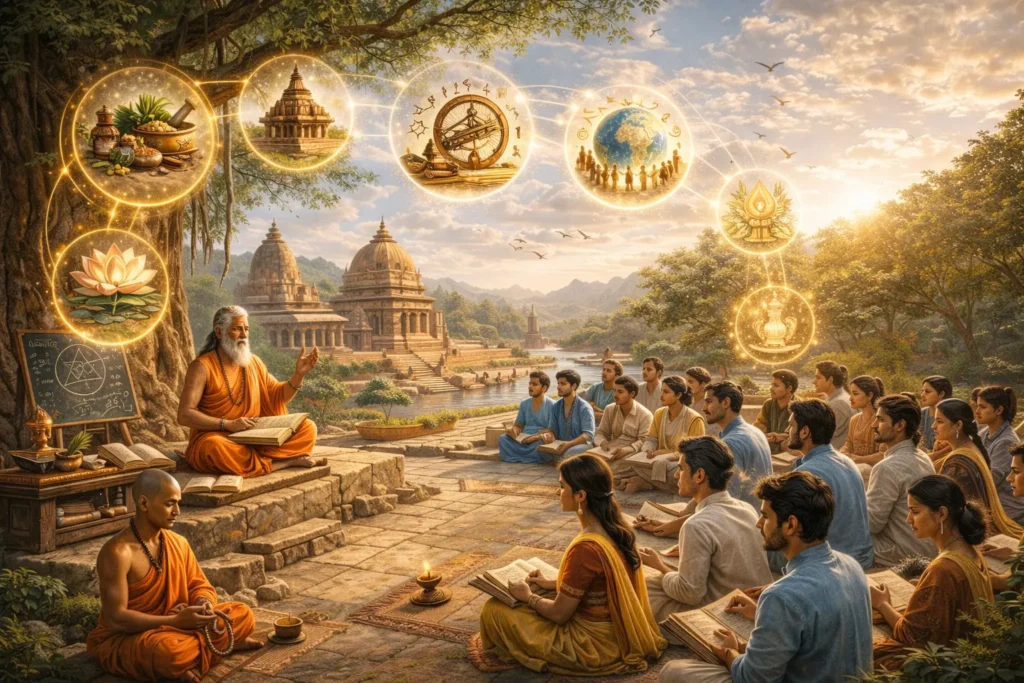
Indian education is deeply grounded in the concept of Bharatiyata, which reflects the
civilisational ethos and cultural identity of the subcontinent. India’s intellectual heritage—
spanning architecture, medicine, mathematics, astronomy, philosophy, literature, and the
arts—forms part of the Bharatiya Gyana Parampara (भारतीय ‘ान परंपरा). These evolving
traditions offer valuable insights for addressing contemporary global challenges.
Colonialism, however, relegated much of this knowledge to archives and libraries.
Reclaiming this heritage requires moving beyond preservation towards active reinterpretation
and application. The works of figures such as Sushruta, Charaka, and Aryabhata must be
revisited through fresh scholarly lenses so that their insights can inform modern research and
practice. Embedding Bharatiyata across the education system—from premier institutions to
grassroots levels—is essential for meaningful transformation
India’s historical achievements in trade, governance, technology, water management,
calendrical sciences, and mathematics illustrate the practical relevance of indigenous
knowledge. Educational approaches grounded in Indian philosophy, which integrate values,
skills, and mindfulness, are seen as fostering harmony and sustainable progress in society and
beyond. Rabindranath Tagore’s vision of education as a holistic process—nurturing the mind,
body, and spirit—remains particularly relevant in this context.Indigenous Knowledge and Peace Studies
A compelling illustration of the need for epistemic plurality can be found in peace and
conflict studies. Western ideas of peace and conflict continue to dominate teaching and
research, often marginalising indigenous and non-Western understandings. Positivist models
of peacebuilding and conflict resolution frequently overlook the cultural, moral, and
normative dimensions of peace embedded in diverse societies.
Contemporary peace researchers increasingly recognise that peace cannot be defined in a
single, universal manner. Instead, peace must be understood as a relational and context-
specific phenomenon that incorporates perspectives from diverse cultures, as well as from
marginalised and subaltern communities. Wolfgang Dietrich’s concept of “many peaces”
challenges the notion of a singular, universal peace and highlights the plurality of peace
traditions pursued throughout history.
In this context, Indian traditions that emphasise inner peace, ethical self-transformation, and
social harmony offer valuable insights. Mahatma Gandhi’s injunction to “be the change we
want to see in the world” provides a powerful bridge between inner transformation and social
peace, demonstrating how personal ethics and collective well-being are deeply
interconnected. Valuing such plural and culturally grounded understandings of peace is not
only intellectually necessary but also vital for addressing contemporary conflicts in an
increasingly interconnected world.
Post Tags:
Share: