
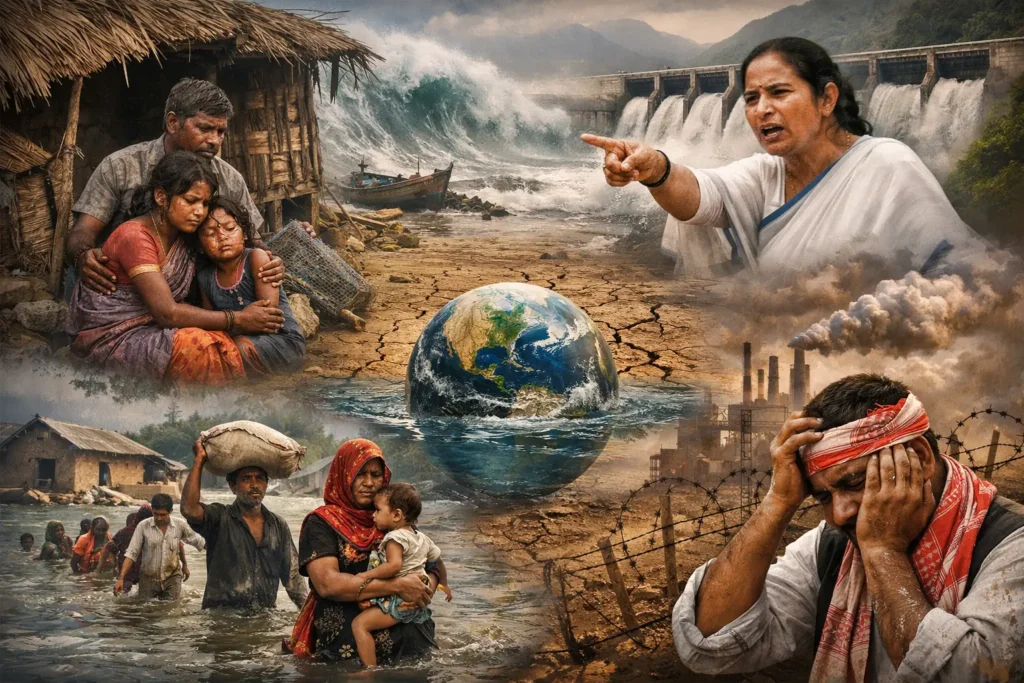
The debate surfaced in a way when heavy rain lashed parts of northern West Bengal – Darjeeling and Jalpaiguri districts in particular on the night of 4-5 October 2025. The region recorded 261 mm of rainfall within a very short time of only 12 hours. While this led to flash floods in all the mountain rivers, it also triggered major landslides. More than 30 people lost their lives – most of them by being buried alive under the debris and by being washed away at night. Ms. Mamata Banerjee, the chief minister of West Bengal, blamed it on Bhutan – a small Himalayan kingdom and the upper riparian in this case – that released flood water from the dams without even sounding any warning. As she is quoted as saying: “We have faced losses due to water coming down from Bhutan… We want them to give us compensation.” This was the first time she sought compensation from the country although she is reported to have blamed Bhutan for holding water on several occasions earlier and suddenly releasing it to the detriment of northern West Bengal.
The problem lies deeper. If climate change is what causes such torrential rainfall and climate extremities within a short span of time, Bhutan alone cannot be held responsible for it. With low or no industrialization, Bhutan has an enviable climate record. The country is said to be the only carbon-negative country in the world. It has a 71 percent forest cover and absorbs more CO2 than what it emits. The country is committed to the conservation of 60 percent forest cover as per its Constitution. If vast areas of northern West Bengal have been adversely affected by recent floods, one could argue that Bhutan too was worst affected by torrential rainfall and climate extremities for which she alone could not be blamed.
One can draw a parallel with Bangladesh in this context. Assam – the largest of India’s northeastern states – has been experiencing large-scale immigration from the neighbouring countries – mainly East Pakistan/Bangladesh for decades. The massive, undocumented immigration has been perceived to have
(i) established the rule of ‘foreigners’ in some of the electoral constituencies of Assam where they have reportedly become a majority;
(ii) caused alienation of land hitherto owned by the natives;
(iii) cut into the employment opportunities that could otherwise have gone to the ‘sons of the soil’; and most importantly
(iv) threatened the survival of the language and culture of the native Assamese population.
On the other hand, a section of scholars and activists based mainly in Bangladesh would argue that the large-scale migration from the country particularly in recent decades has been the result of climate change, global warming, glacial melting, coastal subsidence contributing in a large measure to rapid land loss in a country that has one of the largest population densities in the world. As a result, about 17 percent of Bangladeshis may have to be relocated in the next decade if global warming continues at its current rate triggering a massive exodus from the country. Since Bangladesh alone is not responsible for all this, but is badly affected by it, Bangladeshis have a right to migrate to the adjoining, relatively upper districts in India.
The pecking order bears out twofold implications for us: On the one hand, the very existence of the pecking order prevents any concerted resistance to the unjust climate order that exists throughout the world. Resistance to climate injustice is therefore dispersed and sporadic and can easily melt away. On the other hand, The pecking order of injustice also calls for introducing a new orientation to our understanding of climate justice in the sense that it is far from being a simple act of replacing an unjust order by a just one.
Post Tags:
Share: